What level of downforce you run (front/rear wing) has always been a crucial consideration in the modern F1 games, and on F1 24 it’s no different. All things being equal, I personally prefer a higher downforce setup, because I like that feeling of strong cornering grip and that feeling of the car being stable and planted to the track.
But it’s not always a case of what we prefer giving the best results, especially over longer races. What generally is the best way to go with car setups in F1 24? Is it better to use lower downforce or higher downforce setups?
In general, it is better to use lower downforce setups in races in most cases, since it is much easier to overtake and defend and also easier to save and recoup ERS. Higher downforce setups are better for qualifying and Time Trial but usually less optimal in races.
In other words, for races, it’s often a case of “short term pain, long term gain” in terms of using a lower downforce that might be less optimal for qualifying, but much better in racing, and gives back to you way more than the bit you may have lost in qualifying.
This has been the case on some other recent F1 games (F1 23 and F1 22), but it’s even more extreme now on F1 24. The wing level you set is largely down to the level of straight line speed you need to be able to defend on the straights, which is often 3-5 clicks lower than what’s optimal for single lap pace.
But there are some important caveats to this, so let’s cover the issue in much more detail.
Downforce Requirements Vary By Track
In general terms, different types of circuit always need differing levels of downforce, so when we say lower downforce is generally better, we’re speaking in relative terms here. It wouldn’t be wise to run a Monaco setup at Monza for example, or vice versa. Rather, we mean that on F1 24, it’s generally better for races to run a slightly lower downforce than the pure laps times in practice might tell you.
But generally, here’s all the F1 24 circuits, broken in approximate downforce levels needed:
- Lowest downforce tracks (0-8 wings) – Monza, Baku, Las Vegas, Belgium (down to choice)
- Low-medium downforce tracks (12-18 wings) – Austria, Belgium (down to choice), Miami, Saudi Arabia
- Medium downforce tracks (20-26 wings) – Bahrain, Australia, Imola, Canada, Great Britain, Japan, Mexico, Brazil, Abu Dhabi, China, Portugal
- High downforce tracks (30-36 wings) – Spain, Qatar, Texas, Zandvoort
- Maximum Downforce tracks (46-50 wings) – Monaco, Hungary, Singapore
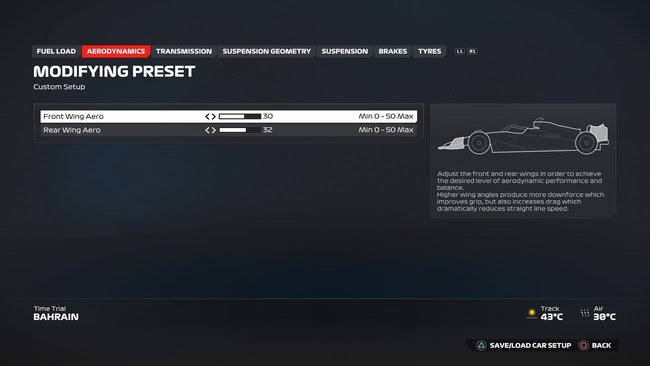
This gives you an idea of the general ballpark levels of wing/downforce you need to be using for each track (see here for generic template setups for each track type). But you can then tweak from there to either take off, or add more wing levels depending on what gives better results.
Bottom line – taking off some wing often helps in races. Let’s look into more detail at how and why.
The Benefits/Costs Of Running A Lower Downforce Level
See the excellent video below which demonstrates how much an advantage a lower downforce setup can give over races
Demonstration Of How Over-powered Low Downforce is on F1 23 (same principle and even more exaggerated on F1 24)
Benefits of running lower downforce:
Overtaking – Better straight line speed which allows for better overtaking to make up positions in the races. You’ll see the time delta drop like crazy on straights, following cars with higher wings. Lower downforce gives such a large advantage on most tracks in the race. With higher downforce setups, even if you’ve got the raw pace, you can be stuck behind another car running lower downforce, wasting your ERS not being able to get past.
Defending (crucial on F1 24) – Same for defending – the straight line speed makes it easier to avoid being overtaken and move forward in races instead of backwards. This is key on the ’24 game- you need to keep your wing levels low enough to be able to use ERS to defend on the straights. Running a wing level that’s optimal for 1 lap pace usually leaves you too vulnerable to being overtaken in the race, so you need to go around 4-5 clicks lower than what might seem ideal to stay competitive on the straights.
ERS Recovery – Is less differentiated on F1 24 than the previous few games, but still noticeable. ERS is a little easier to save and recoup with lower downforce. It runs out less quickly and replenishes better as well. But the ERS modelling is quite lenient on ’24 and so recouping it is possible on all downforce levels.
Costs of running lower downforce:
Qualifying – You will lose some lap time and positions in qualifying. Expect to lose a few tenths versus using a more “optimal” higher downforce setup in terms of pure lap time on some tracks. But this comes back to you much more strongly in the race with the lower downforce benefits listed above.
Bottom line – On F1 24, using lower wings allows you to defend position much more easily, as long as you deploy and harvest your ERS strategically. Whatever levels you were using on the ’23 game, go a few clicks lower still on ’24.
The Benefits/Costs Up Running A Higher Downforce Level
Now let’s contrast this with the pros/cons of running a higher downforce setup at race weekends.
Benefits:
Qualifying – Higher downforce setups will tend to give you better qualifying lap times on medium-high downforce circuits.
Raw pace – On some tracks with less straights, it is true that a higher downforce setup can just give you better raw lap times. If you’re confident you can qualify out front, break DRS and stay out front, it can be the way to go if you can eliminate DRS from trailing cars from the picture during the race.
Costs:
Overtaking/Defending – Much harder to overtake and defend your position with higher wings. ERS, DRS and slipstream combined are so powerful that a car even with a few clicks lower wings can blast past you on straights. And on F1 24, if you’re still in the DRS of chasing cars with wings too high, you’ll be blown past and left for dust as the ERS/DRS/slipstream is even more powerful than it was on the ’23 and ’22 games.
ERS – Is there, but less of a factor on F1 24, as it depletes quickly but also recovers very quickly as well on this year’s game. Once you’ve blown your ERS allocation on a high downforce setup, it’s harder to get but using higher wings but still possible on ’24 with the more generous recharging rate.
Deciding What Downforce Level To Use (Different Scenarios)
Let’s bring everything together so far to just give some bottom line answers as to what level of downforce is best to use in some different race weekend scenarios:
Straightforward dry weekend – When it’s pretty much dry qualifying/race, it’s often better to sacrifice a bit of qualifying position for a better race setup. Find your optimal wing level for best raw lap time, and maybe drop it by 2-3 clicks to be in a better position in the race. If might cost a few tenths and a few positions in qualifying, but you can generally make this back up and more in the race, especially in leagues where the field is spread and a few tenths doesn’t cost you a whole lot in Qualifying.
Highly competitive leagues – eSports level leagues are SUPER competitive now, the the point where pretty much everyone is “dialled in” and there can be only a few tenths between first and last position in qualifying. In these cases, the benefits of low downforce setups are less pronounced, and you may decide you want that qualifying track position more. Weigh up the track and competition and maybe stay with the best setup for single lap pace.
Largely or fully wet weekend – Downforce is king here, since DRS is not in the picture in wet weather. Go for higher wings and get yourself on pole or the best position possible in qualifying, and manage the race from there.
Mixed weather weekend – Use your judgement and decide whether qualifying position or race strategy is more important. Wet quali and dry race – if you’ve got the pace, I’d say get yourself on pole or close to the front with higher downforce, and manage from there. If you’re midfield, sacrifice a bit in quali and get a lower downforce setup that’ll allow you to move forward better in the race. Dry quali and wet race, it’s harder to judge but I’d lean towards higher downforce and use the extra grip and traction in the race.
Qualifying biased track – There are some tracks where overtaking is difficult and therefore track position and qualifying are more important (Monaco, Hungary, Singapore, Zandvoort to an extent). On these tracks, if you’ve got a chance for pole, use the higher downforce setup that will get you on pole, and manage the race from there. Try using your raw pace and ERS to break out of DRS within the first 2 laps of the race, and try to maintain the gap from there.
2 thoughts on “Finding Your Optimum Wing Levels For F1 24 (Low vs High Downforce)”