
All recent F1 games have had some kind of stylized model regarding how tyre pressures affect the handling and tyre temperatures. But on F1 24 it’s somewhat different to how it’s been on previous game, and the swathe of recent patches following the game’s release have changed up the dynamics and confused things even more.
Tyre pressures on this year’s game run on the following scale:
- Front tyres – 22.5 PSI – 29.5 PSI
- Rear tyres – 20.5 PSI – 26.5 PSI
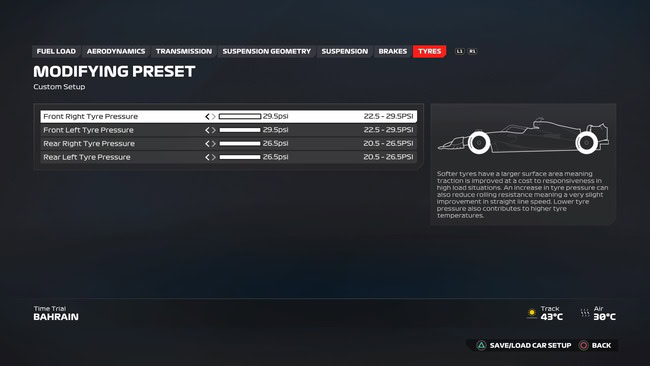
But the bottom line is that tyre pressures aren’t really that important on F1 24, and don’t seem to have a massive effect on bottom line pace. Many players are using maximum tyre pressures for all tyres on F1 24, but in reality the tyre pressures are largely down to personal handling preference.
How Tyre Pressures Affect Handling & Temps
There is an inverse relationship between tyre pressures and temperatures on this game, meaning higher pressures deliver lower temperatures, and lower pressures deliver higher temperatures.
Here’s a quick summary what different pressures settings does for the handlings and temps:
Maximum Tyre Pressures – Maximum straight line speed, lowest tyre temps and maximum high speed responsiveness or “pointyness”. But less optimal in slower speed corners vs using lower pressures. Also negligibly less tyre wear. Most top level players (especially wheel users) seem to be using max pressures, and is necessary on some tracks to prevent overheating especially on the rear tyres.
Minimum Tyre Pressures – Maximum traction and stability (nice planted feel), better low speed (mechanical) grip. Higher temperatures. Slightly slower straight line speed. Definitely try this for qualifying if you want to get more heat into the soft tyre. Car definitely rotates and grips better into 90 degree and slow speed corners using min pressures, but also has more understeer in high speed corners. Also very slightly higher tyre wear.
Middle Tyre Pressures – Midpoint between these two. This is what I’m using at the moment when I can as I want stability and traction with this handling model. However, there’s quite a few tracks now where the choice is kind of taken out of your hands and you need to run maximum pressures to avoid overheating.

Min & Max Pressures Tested Post 1.6 Patch (Not Really A Massive Difference)
Bottom line – when tested, using max vs min pressures only really changes the temps by 5-6 degrees Celsius over a 5 lap run, so it’s not a massive difference. Laps times also very similar. What pressure you use is largely down to personal preference regarding what you want with the handling (traction/stability/mechanical grip vs high speed responsiveness).
Overheating/Underheating Tyres Explained
You ideally want to keep all your tyres within the ideal operating window for each tyre compound/type (but again, on this game, it doesn’t really seem to make much difference).
And conversely, you want to avoid having any tyre go over it’s ideal temperature.
On F1 24, this is roughly as follows:
- Soft tyre (red) – 102-105 Celsius
- Medium tyre (yellow) – 105-107 Celsius
- Hard tyre (white) – 105-107 Celsius
- Intermediate tyre (green) – 65 Celsius
- Full wet tyre (blue) – 55 Celsius
Once any one tyre of each tyre goes above these temps, you’ll see it start to turn yellow on your MFD:

This means it’s overheating and you’ll start to suffer chronic understeer and a general loss of pace. Once the tyres have gone above their ideal window, it’s hard to get them back again, so if you do cross this threshold, it’s better to pit and switch to a harder tyre to avoid losing too much time.
But honestly, it’s pretty hard to overheat the tyres on most tracks on the current (1.7) handling model on F1 24. Running max pressures, you’ll generally get nowhere near overheating the tyres on most tracks. I’m using middle pressures at the moment and I’m still usually getting nowhere close.
However, here are some tracks where you might want to watch out for overheating tyres (rears especially) and run higher pressures:
- Australia
- China
- Spain
- Silverstone
- Hungary
- Qatar
- USA
- Mexico (rears)
- Brazil (rear tyres)
Running minimum pressures is generally fine for Qualifying laps, and is safe even in the race on some gentler tracks if you prefer. You can however run into problems with the Inter and Full Wet tyres, which do have a lower operating window and can start to overheat if you’re running middle or low pressures (been caught out with this already on my own Career mode). So if there’s wet weather due, raise your pressures above the middle to be safe.
Underheating – Honestly, it’s much less of a problem on this game, but occasionally you can run into this when using the white hard tyre especially. If you’re seeing blue on the MFD on any one tyre, it’s a sign they’re not up to the right temperature, and you might get understeer in certain corners. To avoid this, set your pressures lower on that tyre by a few PSI, and/or switch onto a softer tyre if it makes sense.
Optimal Pressures For All Tracks
Now let’s give some optimal tyre pressure settings for all tracks. These settings should prevent tyres overheating as long as you drive reasonably smoothly.
Easy answer – Just use maximum tyre pressures for all tracks. Maybe not optimal, since sometimes tyres may not get into their theoretical ideal operating window. But honestly, maybe doesn’t even make a massive difference on this game.
And then some more customised recommendations for each track:
- Bahrain – Fronts middle pressures; Rears max pressures
- Saudi Arabia – Fronts 28.0; Rears max pressures
- Australia – Max pressures all tyres
- Japan – Fronts 27.5; Rears maximum pressures
- China – Max pressures all tyres
- Miami – Maximum pressures all tyres
- Imola – Middle pressures all tyres
- Monaco – Minimum pressures all tyres
- Spain – Max pressures all tyres
- Canada – Fronts 24.0, Rears minimum
- Austria – Middle pressures all tyres
- Great Britain – Max pressures all tyres
- Hungary – Max pressures all tyres
- Spa – Middle pressures all tyres
- Zandvoort – Fronts 26-27 PSI, Rears maximum (front right lower than front left)
- Monza – Fronts middle pressures; Rears max pressures
- Baku – Fronts middle pressures; Rears max pressures
- Singapore -Middle pressures all tyres
- USA Texas – Max pressures all tyres
- Mexico – Max pressures all tyres
- Brazil – Max pressures all tyres
- Las Vegas – Front minimum pressures; Rears middle pressures
- Qatar – Max pressures all tyres
- Abu Dhabi – Max pressures all tyres
- Portugal – Max pressures all tyres
Out custom setup guides for each track also goes into tyre temperatures for each track, including which tyres to watch most closely for overheating on each track where it’s an issue, plus more nuanced and precise settings for each circuit.
One thought on “F1 24 Tyre Temperatures & Pressures Guide”