The F1 26 Season Pack ERS system makes battery management far more important than in previous F1 games.
F1 26 Season Pack ERS deployment is no longer something you can mostly ignore. If you use it well, you can attack, defend and carry better race pace. If you waste it, you can quickly become vulnerable on the straights.
This guide explains how F1 26 Season Pack ERS works and how to use it properly. For what else changed in the Season Pack, see our F1 26 Season Pack guide.
Why F1 26 Season Pack ERS Matters More in 2026
The 2026-style power unit relies heavily on electrical power. This means your battery has a major impact on acceleration, overtaking and defending.
If you run out of battery before the car ahead or behind, you will struggle to keep up on the straights. The goal is not just to use battery whenever possible. The goal is to spend it where it gives the biggest advantage.
Understanding the ERS Modes
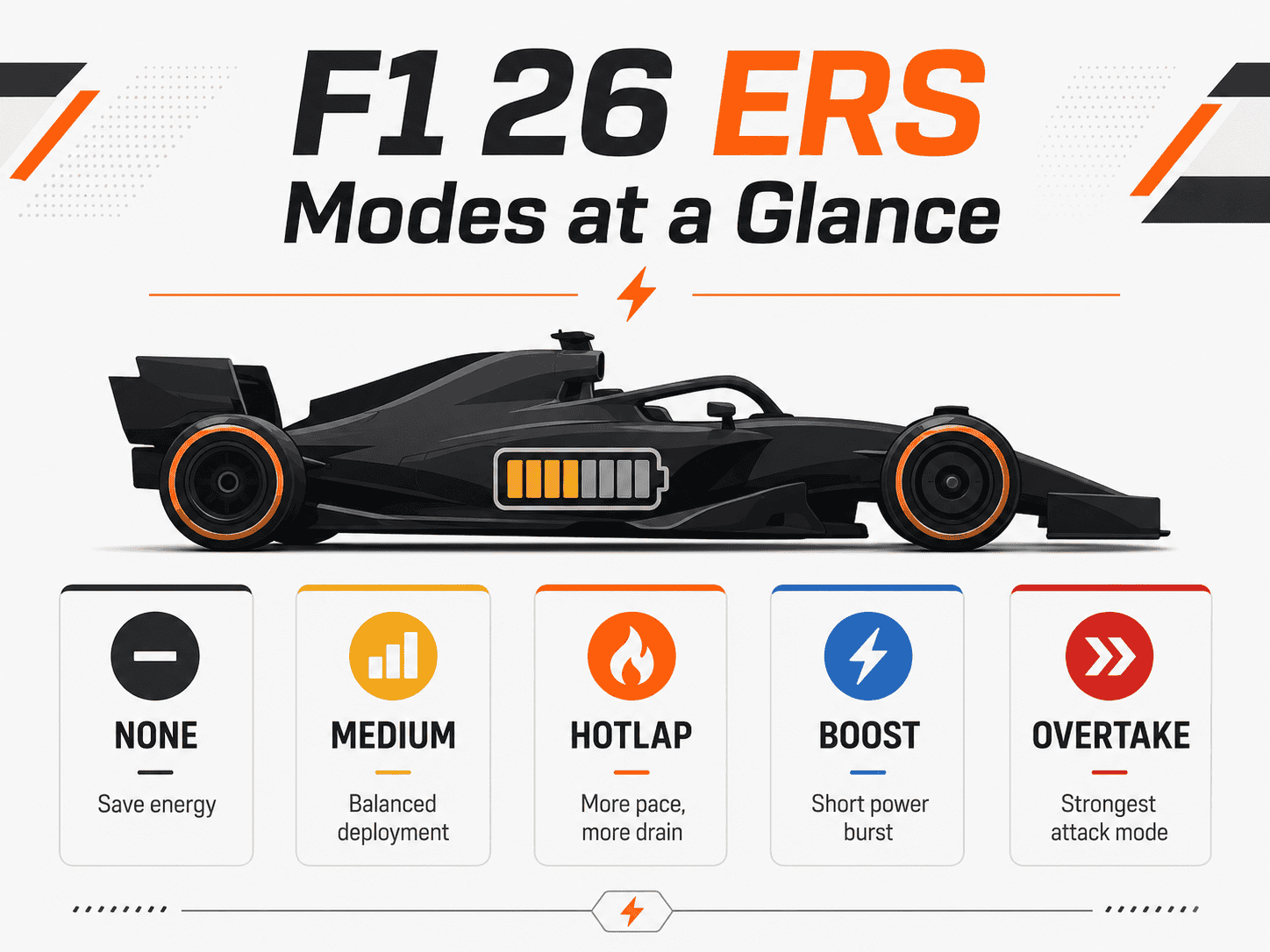
The main F1 26 Season Pack ERS modes are None, Medium, Hotlap, Boost, and Overtake. Each mode changes how much power you deploy and how much energy you can recover.
None Mode
None gives you little or no electrical deployment. Use it when you want to save energy, especially before braking zones, in corners, when traction is limited, or when you are not attacking or defending. Avoid using extra deployment when the rear tyres are already struggling. You may just create wheelspin and waste battery.
Medium Mode
Medium is the safest default option. It gives you some deployment without draining the battery as quickly as Hotlap or Boost. If you are still learning the F1 26 ERS system, Medium is usually the best mode to rely on.
Hotlap Mode
Hotlap gives stronger deployment and is useful when chasing lap time. It is most useful in qualifying or when you need extra speed on a long straight. However, it uses more battery, so avoid leaving it on for too long in a race.
Boost Mode
Boost is your manual power burst. It is most effective when the car is accelerating, especially out of slow corners, at the start of long straights, when attacking, or when defending. Do not waste Boost at the end of a straight when you are already close to top speed. Use it early, where the extra power helps acceleration most.
Overtake Mode
Overtake is now closer to a DRS replacement. If you are within the required gap at the detection point, you can gain access to Overtake for the following lap. When available, it gives you stronger deployment and helps the car accelerate harder for longer.
It may not always let you fly past another car, but it can help you get alongside, defend position or apply pressure.
Why Battery Can Still Drain After Switching Modes
In F1 26, the car does not always cut electrical power instantly when you switch to a lower mode.
If you move from Boost to a lower deployment mode, the battery may continue draining briefly while the system reduces power. This means you need to switch modes earlier than you might expect.
Do not wait until the braking board to save energy. Plan the change before you get there.
Lift and Coast Is Essential
Lift and coast is one of the most important F1 26 Season Pack ERS management skills. It means lifting off the throttle before the braking zone and letting the car coast into the corner. This helps recover battery and reduces unnecessary energy use.
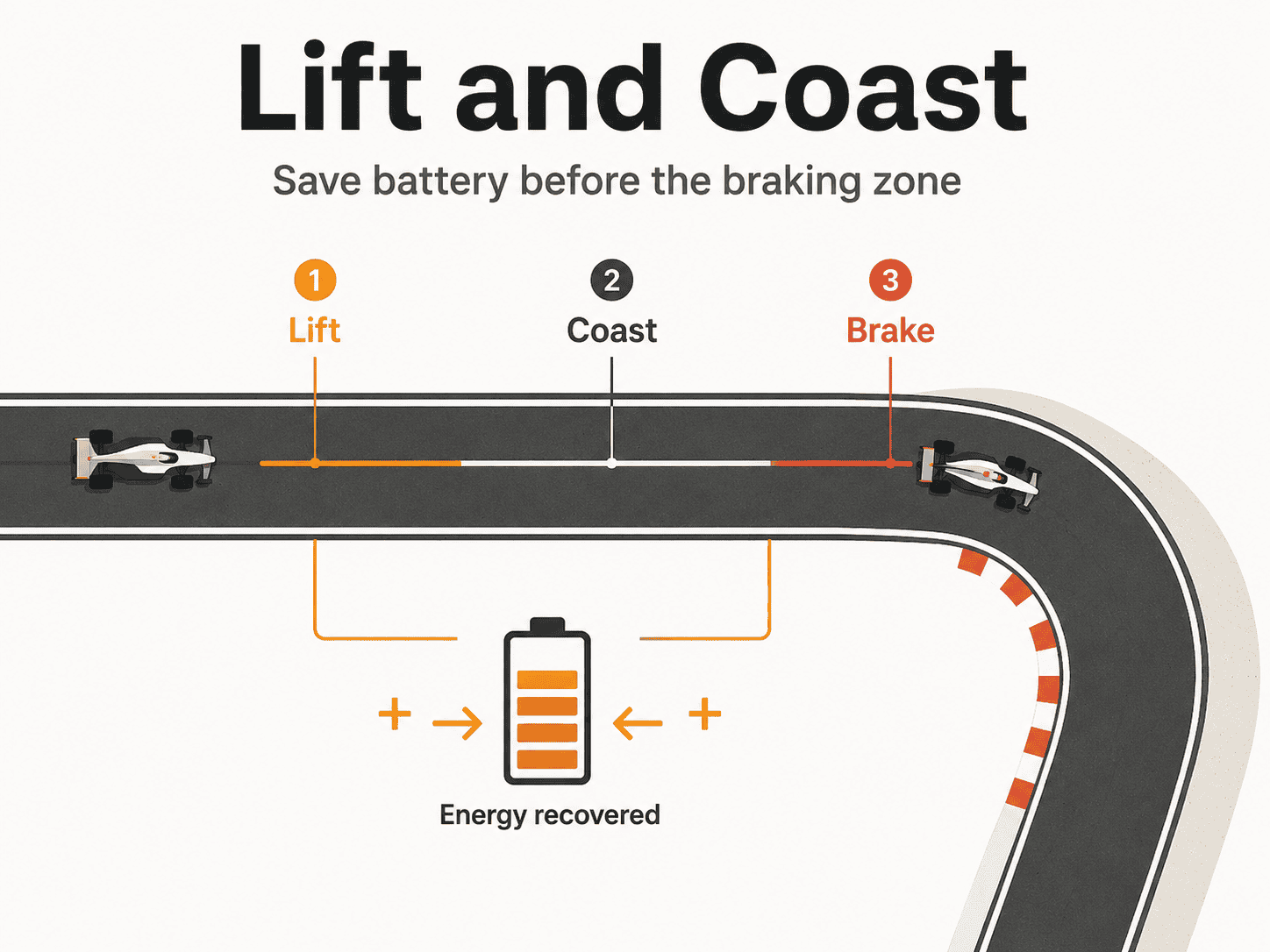
The best places to lift and coast are usually heavy braking zones at the end of long straights. You are already slowing down, so the time loss can be small compared with the battery you recover.
Use lift and coast to recover energy each lap, avoid running out of battery, save power for overtaking zones, defend later in the race, and improve race consistency.
Do not coast everywhere. Focus on the corners where the energy gain is worth the small time loss.
Try a Small Pre-Lift
A useful extra technique is a small pre-lift. Instead of staying fully on throttle until the braking point, lift slightly before the main lift and coast phase. At high speed, this may only cost a small amount of speed, but it can help start battery recovery earlier.
This is useful when you are not close enough to attack, the cars ahead are battling, you want to save for a later straight, or you are preparing to defend. Small gains can add up over a full lap.
How to Deploy Battery on a Lap
A simple ERS pattern to follow each lap:
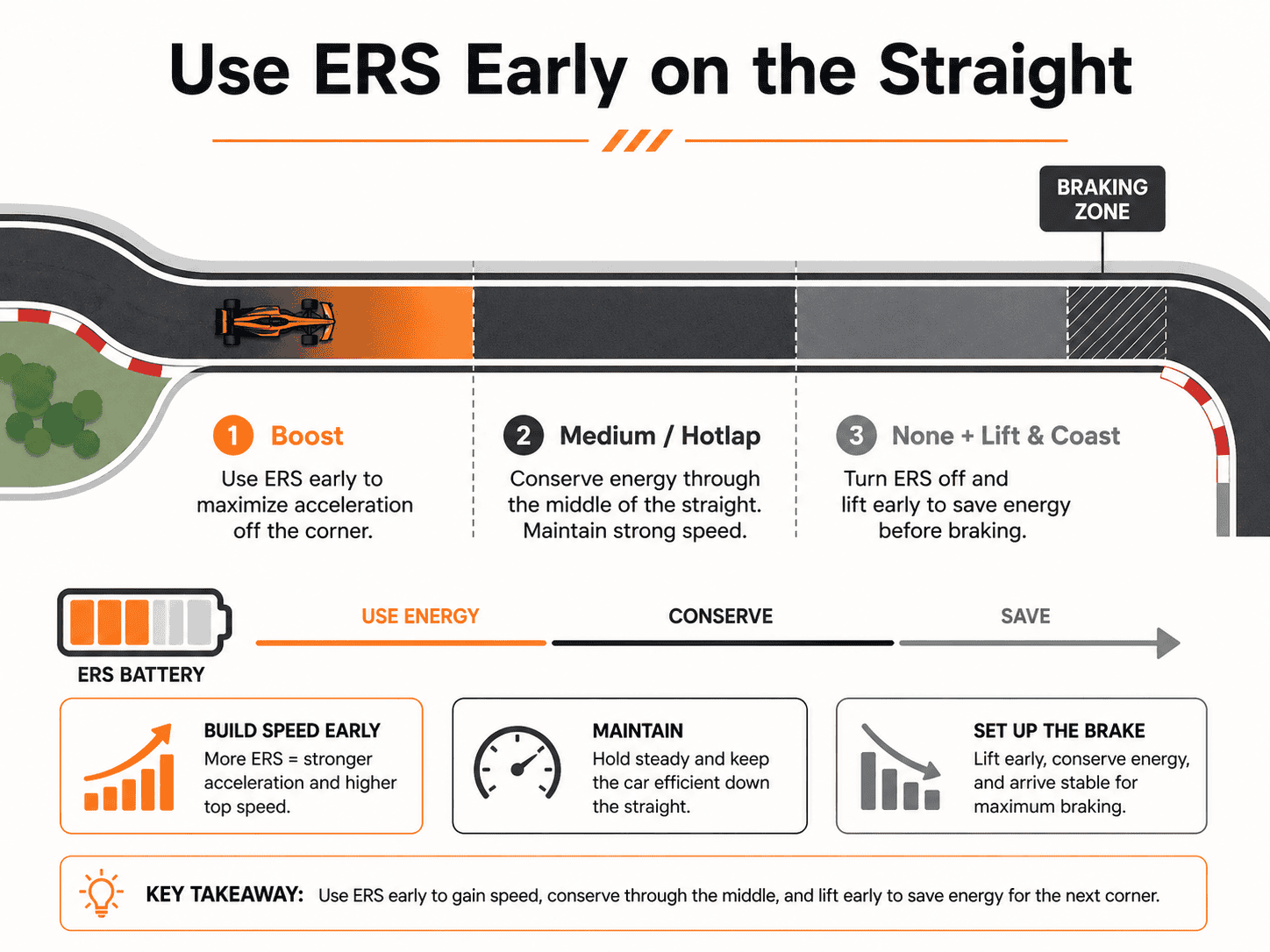
- Use little or no deployment in corners.
- Use Boost on corner exit.
- Use Medium or Hotlap once the car is already accelerating.
- Switch down before the braking zone.
- Lift and coast to recover battery.
- Repeat.
Battery is usually most valuable at the start of straights and out of slow corners. It is usually least valuable when you are close to top speed or about to brake.
Race Battery Management
In races, you need enough battery to attack and defend lap after lap.
Before each race, think about the main overtaking zones, where you need battery to defend, where you can safely save, and which braking zones are best for lift and coast.
Sometimes it is better to save a little in one part of the lap so you have more energy where it really matters.
The key question is simple: how can I get the most benefit from the least battery?
Qualifying Battery Management
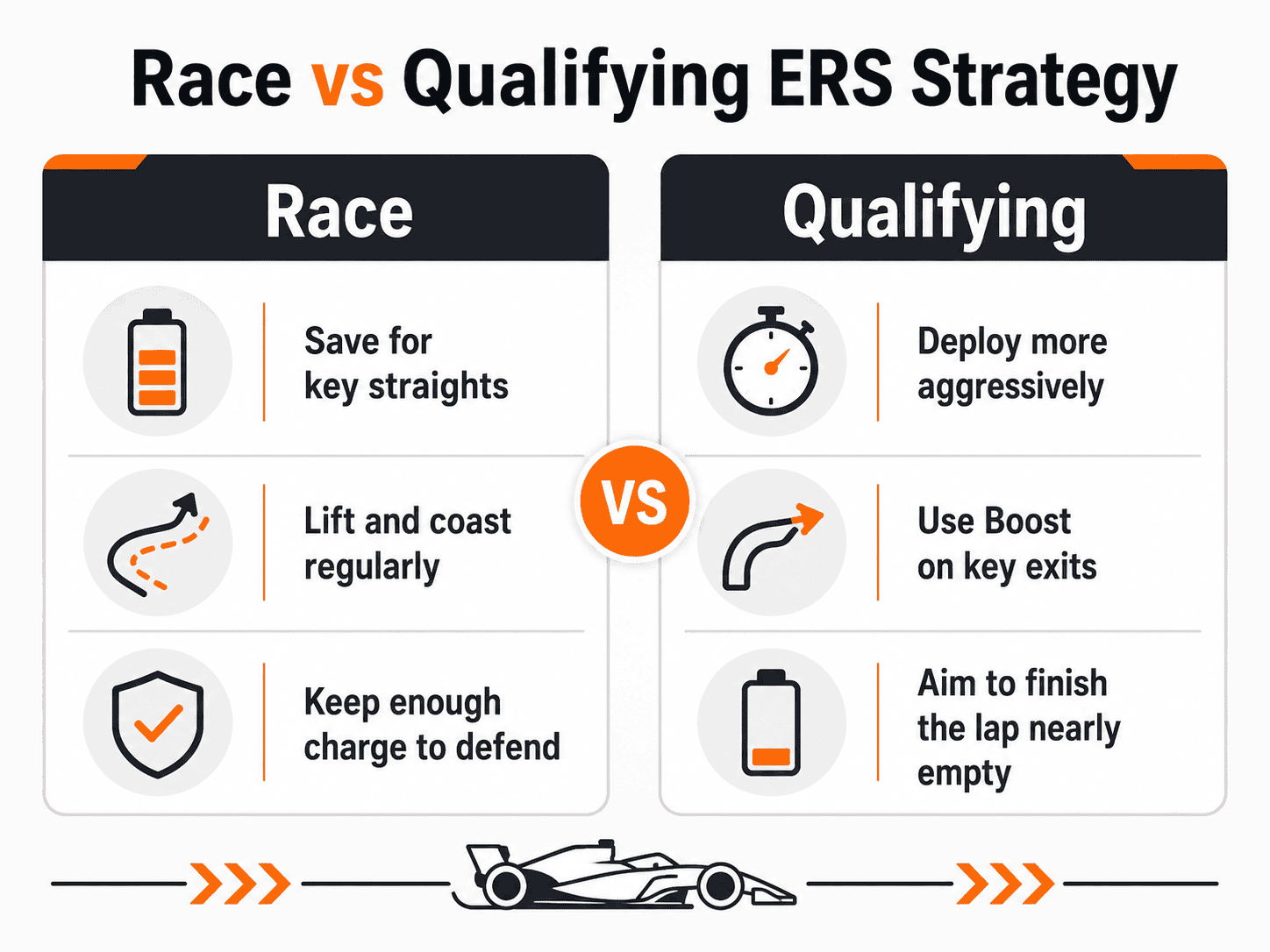
Qualifying is different because you only need to optimise one lap. Your goal is to use the battery aggressively without running out too early. Ideally, you should cross the finish line with very little battery left.
If you finish with a lot of charge, you probably saved too much. If you run out several corners before the line, you probably deployed too early or failed to recover enough.
Even in qualifying, a small lift and coast in the right place can help if it gives you more battery for a more important straight.
Common ERS Mistakes
Avoid these common mistakes: using Boost too late on a straight, leaving deployment on through traction zones, forgetting to lift and coast, spending all battery early in the lap, switching modes too late, attacking with no plan to recover, defending with no battery left, and using the same ERS pattern at every track.
F1 26 Season Pack ERS is now a core part of racecraft. Managing it well can be the difference between attacking and being overtaken.
F1 26 Season Pack ERS: Final Thoughts
The F1 26 Season Pack ERS makes battery management one of the most important skills in the game.
To get faster with F1 26 Season Pack ERS, focus on the basics: use Boost mainly on corner exit, avoid wasting deployment at top speed, lift and coast into heavy braking zones, use None or Medium when saving, use Overtake when available, and plan your battery around the most important straights.
The drivers who manage ERS well will have more options in every race. For validated car setups to complement your ERS strategy, see our F1 26 setups page. They will be harder to overtake, stronger when attacking and more consistent across a full stint.
If you want a stronger starting point for the new season, Track Titan now has F1 26 setup bundles available, including dry and wet setups, with Race and Quali Esports variations being added automatically once ready.